The unglamorous truth about a cat collar is that its most important job is not looking good in photos. It is getting a frightened, escaped cat back through your front door. Even strictly indoor cats slip out through a propped screen door or a delivery left ajar, and the first person to find one is almost never a shelter with a chip scanner. It is a neighbor two houses down, reading whatever is on the collar. Choosing how a cat carries its identification is a decision worth more thought than the pattern on the webbing.
Most cats will actually keep a collar on
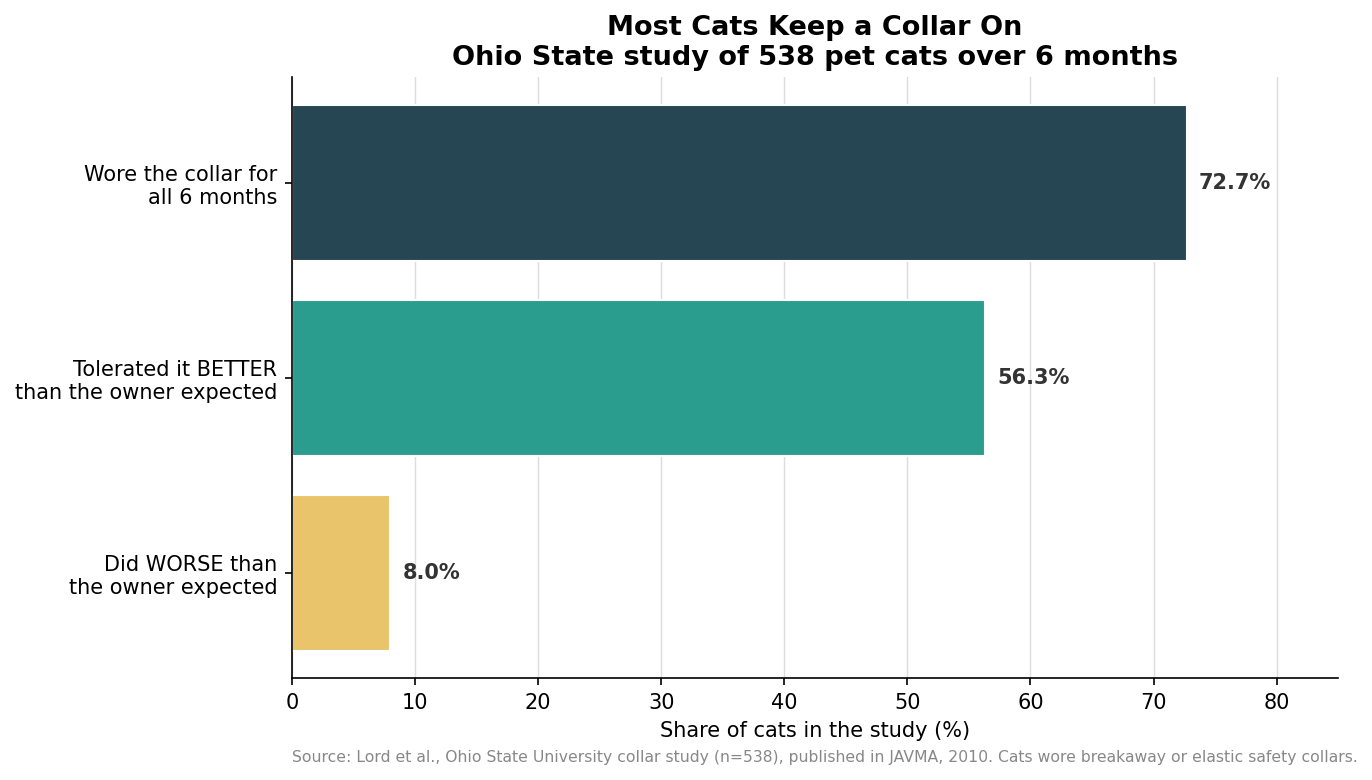
The common objection is that cats will not tolerate a collar, so why bother. The best data we have says otherwise. In an Ohio State University study that followed 538 pet cats over six months, 72.7% wore their collars for the entire period. More striking, in 56.3% of cases the cat tolerated the collar better than its owner had expected, and only 8% did worse than expected. The researchers also found that outcomes tracked owner attitude: cats were likelier to lose collars when their owners doubted the collar would stay on in the first place. The practical read is that a properly fitted collar is worth trying on almost any cat, and that giving up before you start is usually the owner’s hesitation, not the cat’s.
Fit is what makes that number hold. A cat collar should sit snug enough that only about two fingers slide underneath, because a loose collar is the one that snags on a jaw or a paw, and it is also the one that vanishes in the bushes on day two.
Collar ID: printed, embroidered, or a hanging tag
Once the collar stays on, the question is how the cat’s information rides on it, and there are three real approaches. A hanging ID tag is the classic: a small metal or plastic disc engraved with a name and phone number, clipped to the collar’s D-ring. It is cheap, easy to update, and instantly readable, but it jingles, it can catch on things, and the split ring can work its way loose over months of wear. An embroidered or printed collar puts the phone number directly onto the webbing, stitched or heat-printed along the strap. Nothing dangles, nothing falls off, and the information cannot detach from the collar, which makes it the most durable option for a cat that roams. The tradeoff is that the number is fixed at manufacture, so a change of phone number means a new collar. A slide-on tag splits the difference, threading a flat plate onto the strap so it lies flush without dangling while still being replaceable.
For most owners the strongest setup is a collar with the phone number printed or embroidered straight onto the webbing as the permanent, un-loseable layer, plus a lightweight slide-on or hanging tag if you want a second number or an address that you can change later. The point is redundancy: the finder should be able to read a number without having to catch and hold a nervous cat still enough to inspect a spinning disc.
Breakaway safety and the visibility extras
Whatever ID you choose, a cat collar has to be a breakaway design, with a buckle that pops open under sustained pressure so a cat caught on a branch or a fence can free itself rather than hang. That safety requirement shapes the rest: because the collar is meant to release, the ID printed on the strap is your insurance for the times the collar comes off and stays on the cat, versus a tag that leaves with the collar. Two add-ons are worth considering. Reflective stitching or strips woven into the collar make a cat far easier to spot in headlights at dusk, when outdoor cats are most active and most at risk. A bell is a genuine trade-off: it gives wildlife and other people warning that a cat is near, but some cats are bothered by the constant sound, so treat it as optional rather than default.
The collar and the microchip do different jobs
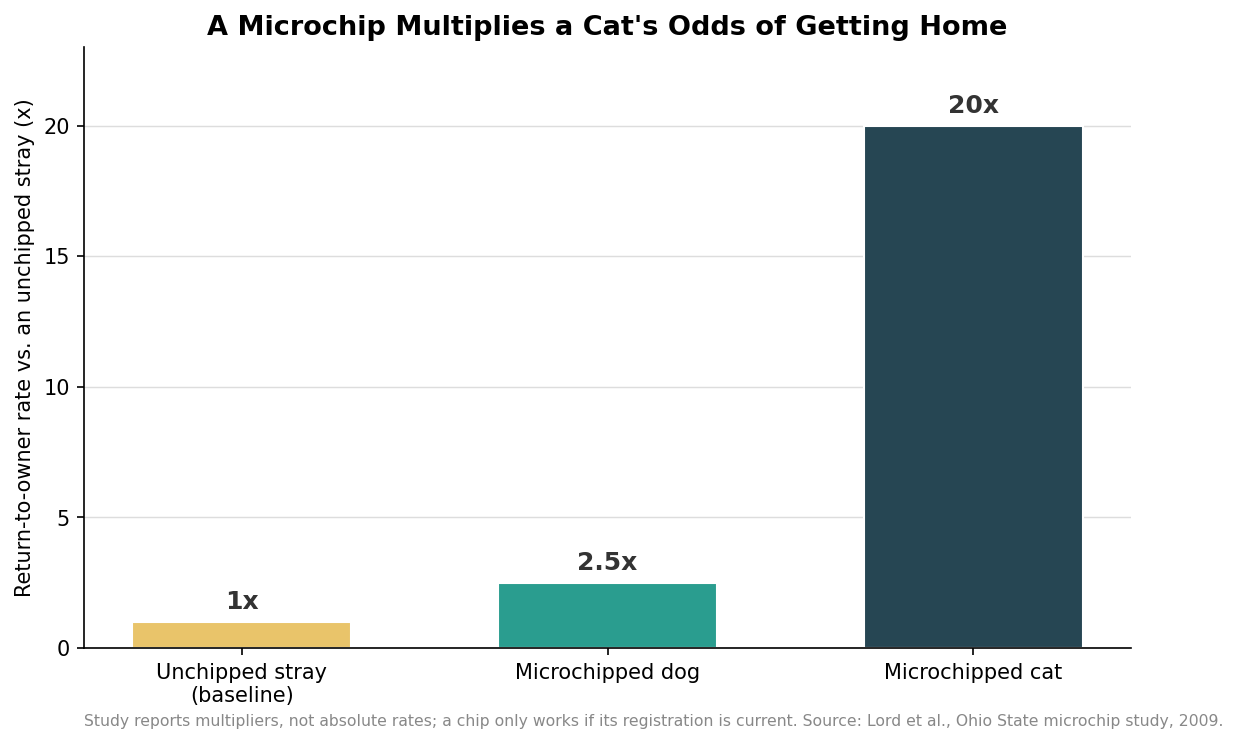
None of this replaces a microchip, and the microchip does not replace the collar. They cover different moments. The chip is the permanent backup that survives a lost collar, and its impact is dramatic: in Ohio State’s shelter research, the return-to-owner rate for microchipped cats was about twenty times higher than for stray cats overall, a far larger effect than the roughly two-and-a-half-times lift seen in dogs. The catch, and it is a big one, is that a chip only works if its registration is current; a chip tied to a disconnected phone number or an old address does nothing.
The collar does the job the chip cannot: it is the visible, immediate ID that a neighbor, a mail carrier, or a passerby can read on the spot, without a scanner, without a trip to a vet or shelter, often within an hour of the cat going missing. That is why the two belong together. Put a breakaway collar with the phone number printed or embroidered onto the webbing on the cat, register the microchip and keep its contact details up to date, and add reflective detailing if the cat spends time outdoors. Each layer covers the gap the others leave, and together they turn a lost cat from a flyer on a lamppost into a phone call from down the street.
Win Free Stuff
Enter below for a chance to win plus receive 10% off your first order.
🎉 You are in!
Check your email for your 10% off code. Good luck!