A cat collar’s material settles three questions at the same time: how well it survives daily wear, how it feels against a thin, short-haired neck, and how it copes with the water, dust, and litter a cat drags it through. Buckles and ID tags get most of the attention, but the webbing or strap is what your cat actually lives in. This is a look at the materials custom cat collars are usually made from, what each one does well, and where each one gives something up.
One rule sits above the material question: a cat’s everyday collar should have a breakaway safety buckle, the kind that pops open under a few pounds of steady pull so a snagged collar cannot trap or choke the animal. Every material below can be built onto a breakaway buckle. Fixed, non-releasing buckles belong on brief supervised outings and harness work, not on a collar a cat wears loose around the house and yard.
Nylon and polyester webbing: the sensible default
Most custom cat collars are cut from woven nylon or polyester webbing, and for good reason. Both are light, hold their shape, resist fraying, and take color and print well. For cats the usual widths are 3/8 inch (about 10 mm) or 1/2 inch (about 13 mm); anything wider starts to look and feel bulky on a five- to twelve-pound animal. Nylon is slightly softer and more flexible out of the box, while polyester holds printed color a touch more crisply and stretches less when it gets wet.
The practical difference shows up in how they are decorated. Polyester webbing takes dye sublimation, which bonds full-color, edge-to-edge artwork into the fibers so it will not peel or crack. Nylon is the friendlier surface for embroidery and for screen or pad printing of a name and phone number. If you want a photographic or multi-color pattern, polyester is the safer bet; if you want a stitched name that reads clearly for years, nylon embroidery is hard to beat.
Cotton and hemp: comfort first
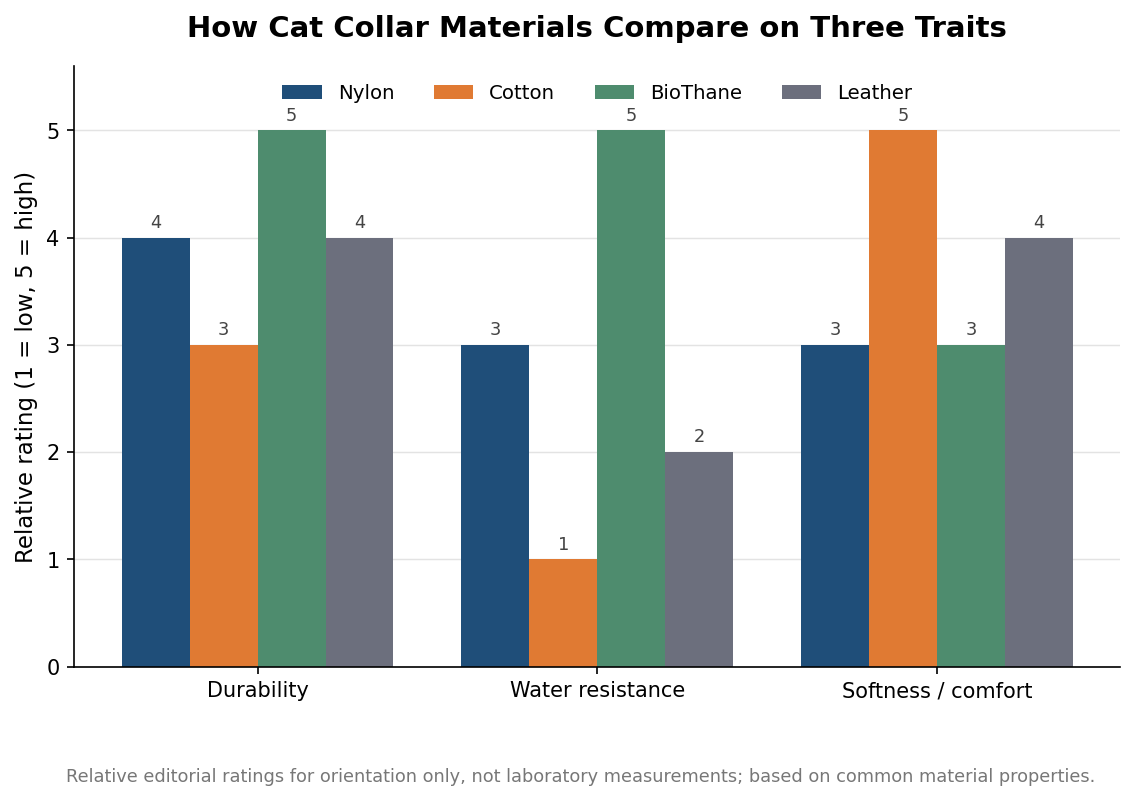
Cotton is the softest common option and the one most handmade and boutique collars use. It sits gently on the neck and comes in an enormous range of prints, which is why fabric-wrapped and patterned collars are almost always cotton over a webbing core. The trade-off is water: cotton absorbs it, dries slowly, and can hold odor and stains after a few soakings at the water bowl or in the rain. A cotton collar usually looks its best for a season or two of steady wear rather than years.
Hemp lands nearby but a little tougher. It is naturally somewhat antimicrobial, softens as it is worn, and resists odor better than cotton, which makes it a quiet favorite for owners who want a natural fiber without cotton’s fading. Neither cotton nor hemp is the choice for a cat who swims, hunts in wet grass, or lives outdoors; for those cats the material list gets shorter.
BioThane: the waterproof outlier
BioThane is a coated polyester webbing that behaves like a soft, flexible plastic. It is genuinely waterproof, wipes clean with a damp cloth, does not hold odor, and shrugs off mud and litter dust that would ruin cotton. For an indoor-outdoor cat, a farm cat, or any cat that finds every puddle, it is the most practical material on this list. It also takes embossing and riveted ID plates cleanly, so a phone number can be pressed straight into the strap.
What you give up is softness and the fabric look. BioThane has a smooth, slightly rubbery hand that some owners love and others find less cozy than woven cloth, and full-color photographic printing is limited compared with sublimated polyester. It is a function-over-fashion material, and it is very good at the function.
Leather: looks the part, asks for upkeep
Leather is the classic, and on a calm indoor cat a slim leather collar looks excellent and grows a nice patina over time. Real leather is strong and can carry a stamped or laser-engraved name or a small riveted plate. The catch is maintenance and water. Leather absorbs moisture, can stiffen or crack if it is repeatedly soaked and dried, and wants occasional conditioning to stay supple. It is also the heaviest option by feel at a given width, so keep it narrow for a cat. Treat leather as a handsome choice for a mostly-indoor cat, not a low-maintenance one.
Matching the material to your cat and your print method
Start from how the cat lives. An indoor cat who mostly naps can wear whatever looks best, so cotton, hemp, or leather are all fair game. A cat who goes outside, hunts, or plays in water is better served by polyester or BioThane, which stay clean and keep their strength wet. Kittens and cats prone to skin sensitivity do well on soft, lightweight nylon or cotton in the narrower 3/8-inch width.
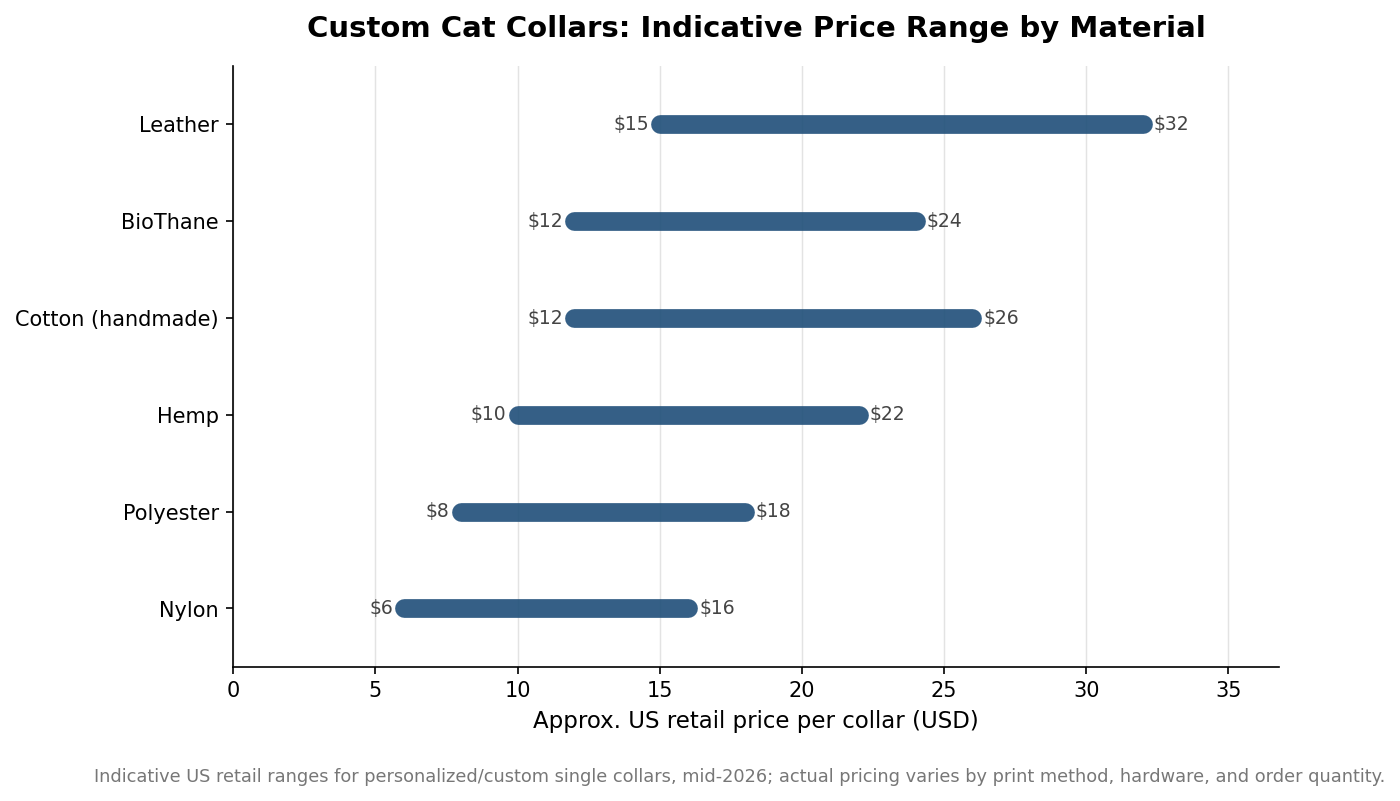
Then match the decoration to the material. Embroidery reads best on nylon and cotton; full-color sublimation needs polyester; embossing and riveted ID plates suit BioThane and leather. Whatever the material, put identification on the collar itself rather than relying only on a dangling tag, since tags are what fall off. Price tracks material and decoration roughly as shown below, and these are indicative ranges rather than fixed figures, since hardware, print method, and order quantity all move the number.
There is no single best material, only the best match for a particular cat. If you remember two things, remember these: keep the collar narrow and on a breakaway buckle for safety, and pick the material for the life the cat actually leads rather than the one in the photo. Get those right and the color, pattern, and stitched name are just the parts that make it yours.